Caught Between Shibuya’s Madness and Shinjuku’s Neon
Most people pass straight through Yoyogi on the Yamanote Line without glancing up from their phones. That’s a mistake, but honestly, it’s why the neighborhood works. Yoyogi sits trapped dead-center between two black holes of overstimulation: the tourist meat grinder of Shibuya to the south and the sensory blitz of Shinjuku to the north.
Because of that squeeze, Yoyogi never bothered becoming a flashy destination. It didn't install themed cafes or giant video screens. Instead, it stayed a low-slung, slightly scruffy pocket where actual Tokyoites live, study design, nurse hangovers, and drink under rusted corrugated tin. It gives you the dense forest greenery of Tokyo's backyard on one flank and gritty alleyways smelling of burnt charcoal on the other. If you hate wading through crowds taking selfies with selfie sticks, Yoyogi is the reset button you hit before you lose your mind.
Low-Slung Backstreets Against Towering Green Canopy
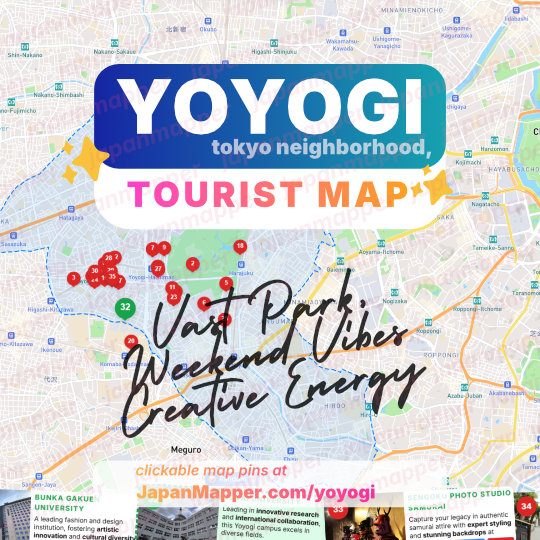
Step out of JR Yoyogi Station’s west exit and the immediate sensory read is concrete, cram schools, and narrow sidewalks jammed with delivery bikes. It doesn't look pretty at first glance. But walk two minutes west and the concrete abruptly slams into an ocean of dense, unmanicured forest: the boundary lines of Yoyogi Park and Meiji Shrine.
The contrast is wild. On the eastern side near the station tracks, you get narrow paths packed with salarymen knocking back draft beer under red lanterns. On the western and southern edges toward Yoyogi-Hachiman and Yoyogi-Uehara, the terrain shifts into a quiet residential sprawl full of boutique bakeries, third-wave coffee counters tucked into converted garages, and residential lanes where you can actually hear bicycle tires hum against the asphalt. It feels like an authentic village that somehow survived inside the world's biggest megalopolis.
Military Barracks, Olympic Ambition, and Leftover Forest
Yoyogi wasn’t always a green sanctuary. Back in the early 20th century, this chunk of land served as a brutal military parade ground for the Imperial Japanese Army. Soldiers drilled here under the cloud of imperial expansion. After World War II, the American military took it over, naming the complex Washington Heights—a fenced-in suburban American town slap in the center of devastated Tokyo, complete with white picket fences and US PX stores.
When the 1964 Tokyo Olympics rolled around, Japan reclaimed the dirt to showcase its post-war rebirth, clearing the military compound to build Kenzo Tange’s radical, suspended-roof gymnasium. The wild part? The sprawling canopy of Meiji Shrine right next door isn't ancient primeval growth. It's a completely man-made, meticulously engineered forest. Over 100,000 trees were hauled in from across Japan and Taiwan in the 1920s, planted with a 100-year plan to naturally regenerate without human interference. The soil underneath your sneakers carries military dust, American occupation roots, and one of the world's most aggressive ecological planning experiments.
Charcoal Smoke and Precision Sourdough
You don't come here for high-end dining courses; you come for two extreme ends of local fuel:
- Smashed offal at Yoyogi Sakaba: Tucked along the railway tracks, the narrow row of drinking shacks known as Hobo Shinjuku Norengai serves unglamorous, salt-heavy charcoal-grilled pork offal (motsuyaki). Order the shiro (intestine) grilled until the edges blister black and crisp, slicked with savory tare sauce that cuts clean through cold lager.
- Fermented bread at 365 Nichi: Down toward Tomigaya on the edge of the park sits this tiny bakery run with lab-like precision. Locals queue up for the Kurokkyu, a feather-light brioche bun loaded with crispy, dark chocolate pearls. The real hero, however, is their wild yeast sourdough, baked with single-origin Japanese wheat that gives off a tangy, distinctly cereal-heavy crumb you won't find anywhere in Western Europe.
Makoto Shinkai's Weather Altar and Otaku Reality
If Yoyogi feels oddly familiar to anime fans, that's because Makoto Shinkai turned it into a shrine for atmospheric gloom in his film Weathering with You (Tenki no Ko). The rusty, rain-slicked rooftop shrine where the protagonist prays the rain away was modeled on the old Yoyogi Kaikan building—a decaying, concrete eyesore that stood near the station for decades before demolition.
Beyond that, the endless, moody green corridors of Yoyogi Park and the surrounding elevated train tracks constantly pop up in live-action dramas and slice-of-life manga whenever an artist needs to convey the feeling of absolute urban solitude inside a city of fourteen million people.
Three Corners Everyone Steps Right Past
- The Meiji Shrine North Gate (Kitasando): 95% of tourists enter Meiji Shrine from Harajuku’s south gate, shuffling shoulder-to-shoulder behind tour flags. Enter instead through the quiet northern approach near Yoyogi Station. You’ll walk down a massive, crushed-gravel cedar tunnel in near-total silence, often accompanied by nothing but the crunch of your own boots.
- Yoyogi Hachimangu’s Jomon Pit Dwellings: Up the stone stairs of this quiet neighborhood shrine, past the moss-covered stone foxes, sits an enclosed archaeological site containing reconstructed prehistoric pit dwellings from the Jomon period (circa 3,000 BCE). People come to pray for business luck and completely miss the fact that Stone Age hunters made hearth fires on the exact same ridge thousands of years ago.
- The Tokai University Footbridge View: Cross the pedestrian overpass near Tomigaya at twilight. You get an unobstructed, head-on view of the elevated Shuto Expressway snaking between low residential rooftops, framing the distant neon towers of Shinjuku without a tourist barricade in sight.
The Walk to the Park Is Not a Breeze
The biggest lie travel guides feed you is that Yoyogi Station is the natural stop for visiting Yoyogi Park. It's not.
Look at a flat map and the park borders Yoyogi Station, but the actual park entrances and the main lawn are a deceptive, exhausting twenty-minute slog around perimeter walls, highway flyovers, and train tracks. If you get off at Yoyogi expecting to immediately spread out a picnic blanket on grass, you will spend half an hour dodging railway crossings in the summer heat before you even spot a blade of lawn. Yoyogi Station is for back-alley food, drinking, and residential wandering; if you just want to flop onto the grass, take the Chiyoda Line to Yoyogi-Koen Station instead.
Three Logistics Tricks for Surviving the Neighborhood
- Ditch the South Entrance Entirely: When visiting Meiji Shrine, take the Yoyogi West Exit and use the Kitasando gate. You skip the train platform crush of Harajuku entirely and hit the shrine grounds without waiting ten minutes just to rinse your hands at the water pavilion.
- Hit the Alleys Before Six PM: The drinking dens in Hobo Shinjuku Norengai pack out instantly after 6:30 PM with local office workers. Grab a wooden stool at an outdoor alley table around 5:15 PM if you want cold beer and yakitori without putting your name on a greasy paper waitlist.
- Ride the Odakyu Line for Escapes: If the crowds at Yoyogi Station feel overwhelming, don't try to cram back onto the JR Yamanote line. Walk seven minutes west to Minami-Shinjuku or Sangubashi on the local Odakyu Line; the platforms are nearly empty, the trains are quiet, and it dumps you straight into western Tokyo’s best neighborhood cafes.