Nijo-jo, Kyoto City
Area Guide

Onions, Whirlpool

Most of Kyoto's great landmarks speak in the language of spiritual refinement — temples oriented toward contemplation, shrines embedded in nature, imperial architecture calibrated for elegance. Nijo Castle speaks in an entirely different register. It is wide moats, colossal stone walls, and rooms painted with tigers and leopards. It is, deliberately and unmistakably, a display of power.

That contrast — samurai swagger planted in the middle of an imperial city — is what makes the Nijo area worth more than a passing visit.

The Political Statement You're Walking Through

When Tokugawa Ieyasu unified Japan and established his shogunate in Edo, he built Nijo Castle in Kyoto for a specific purpose: to keep watch over the Emperor. He positioned it close to the Imperial Palace, then made it larger, flashier, and more heavily fortified. The message was architectural rather than spoken, but it was not subtle.

Walking the castle grounds today is walking through a 400-year-old argument about where power actually resided in Japan. The Emperor lived nearby in considerably less ostentatious surroundings. The shogun's Kyoto residence looked like this.

What to Spend Your Time On

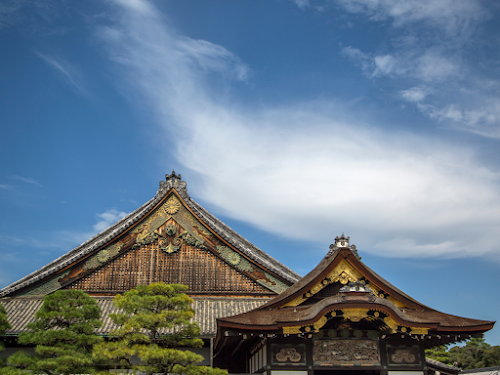
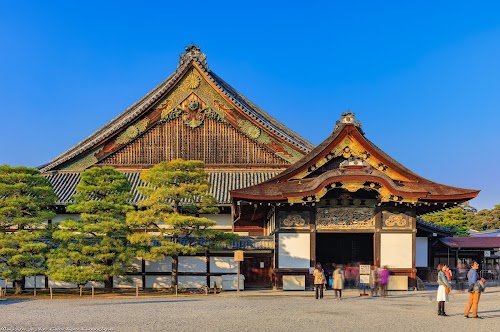
The Karamon Gate announces the castle's intentions before you've gone anywhere. Its woodwork — cranes, pine trees, ornamental lions carved in elaborate relief — is the 17th-century equivalent of a gilded front door, designed to communicate wealth before any conversation begins.

Inside, Ninomaru Palace is the genuine centerpiece. A sequence of interconnected rooms, each more lavishly decorated than the last, lined with painted screens depicting leopards, tigers, and flowering trees. The quality of craftsmanship is extraordinary, and the progression through the rooms — each calibrated for a different level of audience with the shogun — gives the building a narrative logic that rewards slow attention.

The Ninomaru Garden, designed around a large pond with ornamental stones and precisely shaped pines, manages to feel composed rather than manicured. In any season it earns its reputation, but autumn and early spring are particularly strong.

The Nightingale Floors: A Better Story Than the Truth, but Worth Telling Anyway

Nijo Castle's most famous feature is the uguisubari — the nightingale floors of Ninomaru Palace, which produce a soft chirping sound underfoot as you walk. The standard explanation, repeated in guidebooks and tour scripts, is that they were engineered as an anti-assassin security system: a deliberate early-warning mechanism designed to betray the approach of anyone moving through the corridors at night.

Architectural historians have largely rejected this. The chirping is now understood to be the result of wood aging and contracting over centuries, rubbing against the metal clamps and nails that hold the flooring structure together. It is accidental rather than designed — the byproduct of a building growing old in a particular way.

This makes the floors somewhat less dramatic as a story and no less remarkable as an experience. The sound is real. Walking through a 400-year-old palace that chirps softly with each step remains one of the more unusual sensory experiences in Kyoto.

The Garden Next Door That Most People Walk Past

Immediately adjacent to the castle, separated from the tourist flow by nothing more than a low wall and a lack of signage, Shinsen-en Garden predates Nijo Castle by centuries. It was originally part of the Heian Imperial Palace complex — one of the oldest gardens in Kyoto, preserved through successive eras of construction around it.

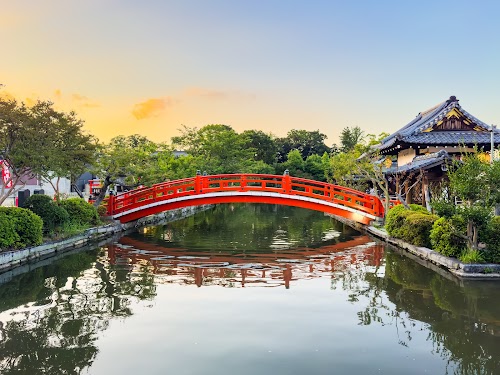
Today it holds a pond, a red bridge, and the kind of slightly overgrown tranquility that formal gardens rarely achieve. It is also, according to local legend, the site where a monk successfully petitioned a dragon god for rain during a historic drought — a story the garden neither confirms nor denies, but the water does have an unusually still quality on calm days.

As Seen On Screen: Nijo-jo's Actual Pop Culture Footprint

Forget "generic samurai vibes"—Nijo Castle has a concrete footprint in film and television, both as a shooting location and the real-life stage for historical epics.

  • The Real Shōgun: If you loved the massive hit series Shōgun, this is a must-visit. Nijo Castle was built by Tokugawa Ieyasu—the real-life historical figure that the brilliant Lord Yoshii Toranaga is based on. When you walk these halls, you are walking through the literal, historical endgame of that show's power struggle.
  • Actually Filmed Here: While many period dramas just build studio sets to mimic Nijo's iconic look, the legendary 1999 samurai film Gohatto (Taboo), directed by Nagisa Oshima and starring Takeshi Kitano, actually used the real Nijo Castle grounds as a filming location.
  • The Hollywood Red Carpet: The castle’s historical gravity is so well-respected that in 2003, it hosted the massive Japanese premiere for Tom Cruise's epic The Last Samurai. They rolled out the red carpet right on the castle grounds!
  • Legend & Butterfly (2023): This recent historical blockbuster starring Takuya Kimura heavily features Nijo Castle in the narrative. To protect Nijo's actual delicate artifacts, they had to cheat a little and film the wild "Nijo Castle sumo tournament" scene at nearby Sennyuji Temple, but the story revolves directly around the castle's legacy.
Nijo-jo, Kyoto City Tourist Attraction Spot Map Area Guide