Melon Kuma: Yūbari’s Savage Mascot That Turned Cute Culture Upside Down
January 25, 2026 (9mo ago)
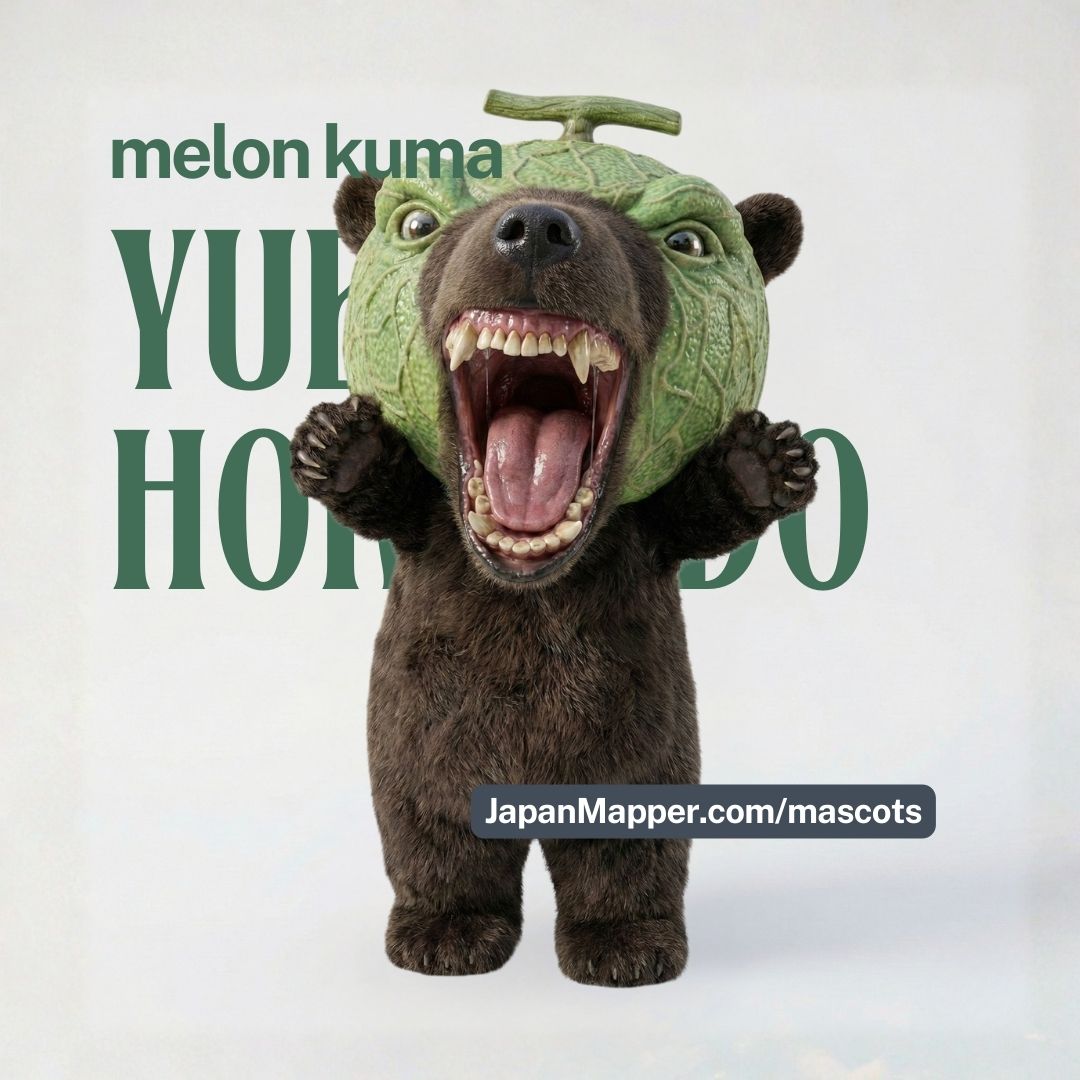
In the crowded landscape of Japanese regional branding, Melon Kuma (メロン熊) is a horrifying anomaly. He is the official mascot of Yūbari City, Hokkaidō—a former coal-mining hub now famous for its luxury melons.
Unlike the soft, round aesthetic of typical Japanese mascots (yuru-kyara), Melon Kuma is a grotesque hybrid: half-bear, half-melon. With razor-sharp teeth, blood-stained claws, and protruding veins on his melon-rind head, he does not wave to tourists. He lunges at them.
And somehow, this nightmare fuel is a marketing masterpiece.
The Lore: A Darker Shade of Branding
While most mascots have whimsical backstories, Melon Kuma’s is intentionally feral. The official lore states that a bear living in the mountains of Yūbari ate too many delicious local melons, mutated into a monster, and now terrorizes the town in search of more.
This narrative achieves two things:
- Product Placement: It aggressively highlights the irresistibility of Yūbari melons.
- Regional Realism: It plays on Hokkaidō’s very real danger of brown bear attacks, grounding the parody in a terrifying local truth.
The Economic "Why": Desperate Times, Extreme Measures
To understand Melon Kuma, you must understand the desperation of his hometown.
In 2007, Yūbari City declared bankruptcy, the only Japanese municipality to effectively do so in modern times. By the 2010s, the city was facing rapid depopulation and a collapse in tourism revenue. A cute, waving character would have vanished into the noise of Japan’s mascot saturation.
Yūbari didn't have the budget for a massive ad campaign, so they opted for Shock Marketing. They needed a character impossible to ignore. Melon Kuma was designed not to be loved, but to be looked at.
The Strategy: "Anti-Kawaii" & The Viral Algorithm
Melon Kuma operates on a strategy of high-arousal emotion. Marketing psychology tells us that "awe" and "anger/fear" drive shares more than "contentment."
- The Interaction Loop: On social media, Melon Kuma doesn't pose; he attacks. He "mauls" other mascots, bites tourists, and growls at children.
- User Generated Content (UGC): When a mascot bites your head, you take a picture. These photos flood Twitter (X) and Instagram, traveling far beyond Japan.
- Global Reach: His design is so visually jarring that he frequently appears on international news and Reddit threads labeled "Japan is crazy," earning Yūbari millions in free earned media value.
By The Numbers
Beyond the scary suit, there are fascinating statistics and cultural nuances that drive this brand.
- The "Shishimai" Effect (The Biting Statistic): Why do parents let a bear bite their toddlers? It draws upon the Japanese tradition of Shishimai (Lion Dance). In folklore, if a lion bites a child's head, it brings good health and wards off evil spirits. Melon Kuma effectively hacked this ancient superstition to turn "assault" into a "blessing."
- Population Density vs. Brand Impact: Yūbari has a population of fewer than 7,000 people (down from 120,000 in its coal peak). For a town this small to have a mascot with national recognition roughly on par with major prefectural mascots is a statistical anomaly in ROI (Return on Investment).
- Merchandise Irony: Analytics from mascot shops often show a high conversion rate for "cute" versions of scary characters. Melon Kuma merchandise often softens his look just enough (chibi-style) to create an "Irony Gap." Consumers buy the merch because the contrast between the violent source material and the cute keychain is funny.
- The "Loose" vs. "Serious" Categorization: In the Yuru-kyara Grand Prix, Melon Kuma rarely wins the top spot. However, his Brand Recall score is significantly higher than many winners. He proves that winning a popularity contest is not the same as being memorable.
Final Thoughts: When Being "Wrong" Is Right
Melon Kuma proves that successful branding doesn't require universal appeal; it requires distinctiveness.
For a city fighting invisibility, safety was the enemy. By embracing a "villain" persona, Yūbari reclaimed the narrative. Melon Kuma teaches us that in a sea of sameness, the jagged edge is what catches the customer's eye.